Leave a Message

Thank you for your message. We will be in touch with you shortly.

Navigating Trust & Estate Home Sales: How to Prepare a Loved One's Home for Sale Without Feeling Overwhelmed

Blog
Navigating Trust & Estate Home Sales: How to Prepare a Loved One's Home for Sale Without Feeling Overwhelmed

Selling a loved one's home after a loss can feel overwhelming. This educational series is designed to answer common questions and help families understand the real estate process with confidence. While these articles are for educational purposes only and are not legal or tax advice, they provide guidance on the real estate side of trust and estate home sales.
How to Prepare a Loved One's Home for Sale Without Feeling Overwhelmed

A Compassionate Guide for Families Selling an Inherited Home in Central Oregon

Preparing a loved one's home for sale can be one of the most emotional parts of settling an estate.

You're not simply cleaning out a house. You're sorting through years of memories, deciding what to keep, what to share with family, and what to do with everything that's left behind—all while trying to understand what needs to happen next.

If you're feeling overwhelmed, you're not alone. You don't have to do everything at once.

A thoughtful plan can help you move through the process one step at a time while giving your family room to make decisions at its own pace.

If you're just beginning the process: Our guide, [Selling a Parent's Home Held in a Living Trust: A Step-by-Step Guide], explains what families can generally expect when a home is held in a living trust.
Start With What Matters Most

When you first begin preparing the home, resist the temptation to immediately start emptying every room.

Instead, start by identifying the things that need attention first:
  • Trust or estate documents
  • Property and financial records
  • Insurance information
  • Valuables and jewelry
  • Family photographs
  • Important personal records
  • Family heirlooms
If the property is part of a probate estate, the personal representative has responsibilities to identify and safeguard estate property. The Oregon Judicial Department notes that a personal representative must take immediate control of and safeguard the deceased person's property.

For a home held in a living trust, the successor trustee should follow the trust's instructions and obtain appropriate legal guidance.

Before anything is sold, donated, or discarded, make sure the person with legal authority has determined what should happen to the property.

Give Yourself Permission to Slow Down

One of the biggest mistakes families can make is feeling like everything needs to happen immediately.

Some things may require prompt attention—such as securing the property, maintaining utilities, or addressing insurance coverage.

But not every decision needs to happen right away.

A box of old photographs can wait.

A collection of family recipes can wait.

Deciding who should receive a favorite piece of furniture can wait.

Instead of asking:

"How quickly can we empty the house?"

Try asking:

"What needs to happen now, and what can wait?"

That simple shift can make the process feel much more manageable.
Create a Simple Family Plan

If multiple family members or beneficiaries are involved, have a conversation before everyone starts taking belongings.

Talk about:
  • Who is responsible for making decisions
  • Who has authority to act for the trust or estate
  • Which belongings have sentimental value
  • Whether family members want specific items
  • Whether an estate sale makes sense
  • What should be donated
  • What needs professional appraisal
Creating a simple plan early can help prevent misunderstandings later.

Remember, the goal isn't simply to empty the home.

It's to responsibly prepare the property while respecting the people and memories connected to it.

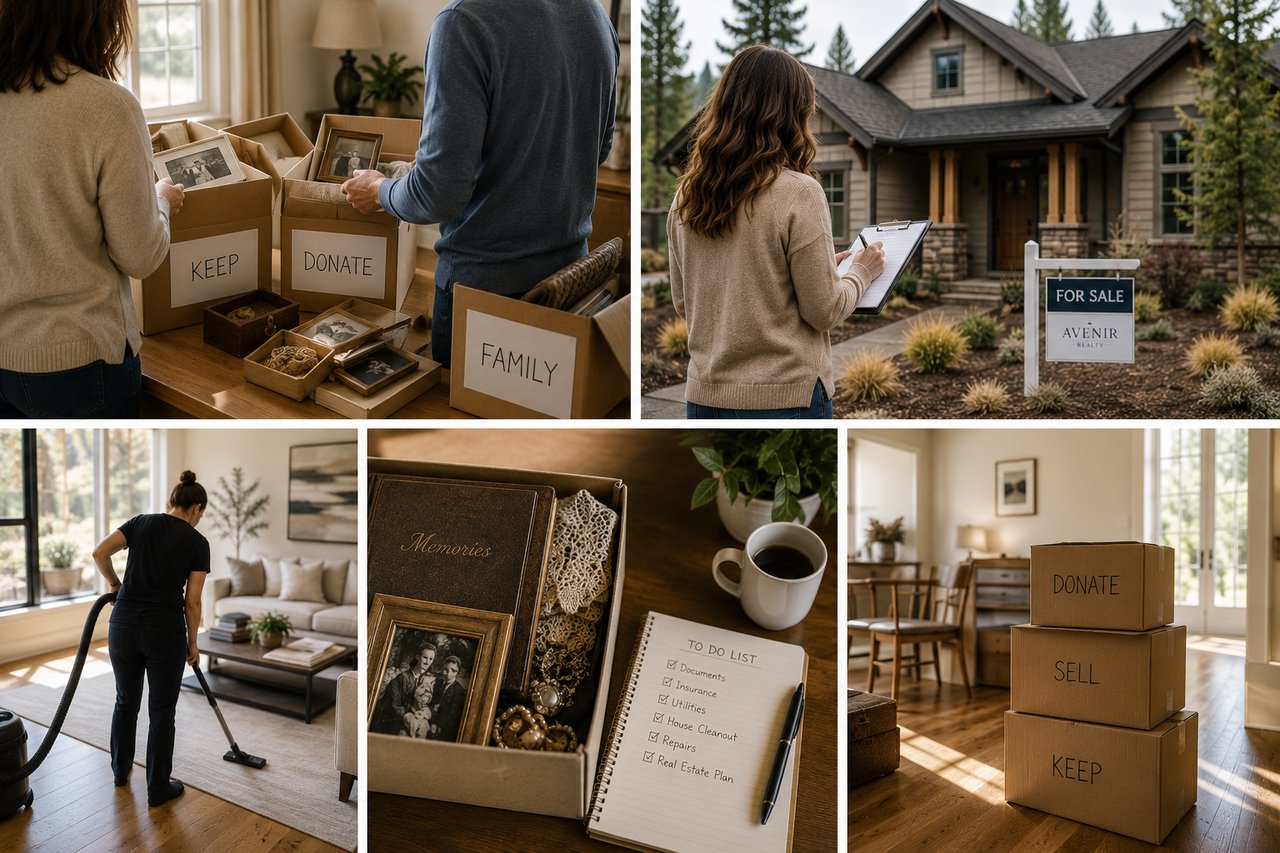
Sort Belongings in Simple Categories

You don't need a complicated system.
Four or five categories are often enough:

Keep
Items family members want to retain.

Family
Heirlooms or meaningful belongings that need to be distributed among family members.

Sell
Items that may have enough value to justify an estate sale or other selling method.

Donate
Clothing, books, household goods, furniture, and other items that could benefit others.

Dispose
Broken, damaged, expired, or unwanted items that cannot reasonably be donated or sold.

If an item is valuable or there is disagreement among beneficiaries, consider consulting the appropriate estate professional before making a decision.
Consider Getting Help

You don't have to sort through everything yourself. Depending on the situation, professional help can make the process significantly easier.

A professional organizer can help sort and categorize belongings.

An estate sale company can manage the sale of furniture, household goods, collectibles, and other personal property.

A cleaning service can handle deep cleaning after the home has been cleared.

And if family members live out of state, a local professional can help coordinate services and property visits.

As a REALTOR®, our role isn't to replace your attorney or financial advisor. Instead, we can help with the real estate side of the process and connect families with local professionals when appropriate.

Don't Renovate Before Understanding the Market

Once belongings have been handled, families often ask:

"How much should we fix before selling?"

The answer isn't always "as much as possible."

Before investing in a major kitchen remodel, new flooring, or other expensive improvements, talk with a local real estate professional about the property's condition and what buyers in the area are actually looking for.

Depending on the home, the best strategy may be:
  • Minimal preparation
  • Cosmetic updates
  • Targeted repairs
  • Professional cleaning
  • Light staging
  • Selling the property as-is
The right choice depends on the property, neighborhood, current buyer demand, and expected return on investment.
Prepare the Home for Its Next Chapter

Once the belongings are organized and necessary repairs are addressed, it's time to think about how buyers will experience the home.

Simple preparation can include:
  • Removing excess furniture
  • Deep cleaning
  • Cleaning windows
  • Refreshing landscaping
  • Completing obvious minor repairs
  • Maximizing natural light
  • Professional photography
The goal isn't necessarily to make the home look brand new. It's to help buyers see its potential.

Don't Forget About a Vacant Home

If the property is going to sit vacant while the family prepares it for sale, it needs regular attention.

Depending on the property and insurance requirements, this may include:
  • Regular property checks
  • Landscaping
  • Maintaining appropriate utilities
  • Security
  • Mail management
  • Seasonal maintenance
  • Reviewing insurance coverage
A vacant property may have different insurance requirements, so contact the insurance provider promptly and ask what coverage is appropriate.
What If You Live Out of State?

Many Central Oregon homes are owned by people who live elsewhere, so an inherited property may be several hours—or several states—away from the family responsible for it.

If you're handling the process remotely, consider building a local team to help coordinate:
  • Property visits
  • Cleaning
  • Landscaping
  • Repairs
  • Donations
  • Estate sales
  • Photography
  • Real estate marketing
Having one local point of contact can make a remote estate sale much easier to manage.

A Simple Four-Step Approach

When everything feels overwhelming, remember four simple steps:

1. Protect
Secure the property and address immediate concerns.

2. Preserve
Set aside important documents, valuables, photographs, and heirlooms.

3. Prepare
Sort, donate, sell, clean, and address necessary repairs.

4. Present
Prepare the home for photography, showings, and the market.

You don't have to complete all four steps in a weekend. One step at a time is still progress.
Final Thoughts

Preparing a loved one's home for sale isn't simply a real estate project.

It's a transition.

There may be moments when you stop to look through an old photograph, open a drawer filled with memories, or realize that a familiar home will soon belong to someone else.

Give yourself and your family permission to move through the process thoughtfully.

You don't have to empty the house in a weekend. You don't have to make every decision alone. And you don't necessarily have to spend thousands of dollars preparing the property.

With the right plan and the right professionals around you, the process can become more manageable—one step at a time.

If your family is preparing to sell a loved one's home in Bend, Sisters, Redmond, Sunriver, or elsewhere in Central Oregon, Avenir Realty is here to help with the real estate side of the journey.

Your family has enough to navigate. The home sale doesn't have to add to the overwhelm.

Explore more blogs Topics in this series.

Previous:

Previous:
Educational Disclaimer

This article is provided for educational purposes only and should not be considered legal, tax, or financial advice. Every trust and estate is unique. Please consult with a qualified estate planning attorney, CPA, or financial advisor regarding your specific situation.

All information deemed reliable but not guaranteed. If your property is listed with a real estate broker, this is not a solicitation of brokerage services. AvenirRealty, License , Avenir Realty.

This email was sent to • View OnlineUnsubscribe • Powered by ActivePipe, a MoxiWorks Product
Equal Housing Opportunity

ActivePipe Message ID: 4004442

Work With Us

Serving all of Central Oregon, we specialize in sellers and buyers looking to downsize for retirement, move into a larger home, or a home with closer proximity to trails, rivers, or local amenities.